The essay below was an assignment from my college-level art history course from 2025-2026 coving the Middle Ages to the Baroque period. The assignment was to choose a work from each of the listed eras and explain why they were the essence of the given cultural time. The essay below is my intellectual property unless otherwise cited.
Three Artworks that Exemplify the Essence of the Middle Ages, Renaissance, and Baroque Era
From around 450 AD to the late 1700s, the art world underwent dramatic changes in what is considered acceptable and desirable. From works of dedication to the Christian god to seeing man in his truest form, the Middle Ages, Renaissance, and Baroque eras in art history are full of symbolism, storytelling, and a raw cataloging of human interests and, ultimately, how the views of the world were changing as war, plagues, luxury, and ideals were constantly shifting. This paper will use three selected works, one from each of the aforementioned periods in art history, to summarize these points in humanity.
Middle Ages
The Middle Ages span from around 450 AD to the 1400s. The art of the Middle Ages is almost exclusively religious in nature, as those who had the resources and knowhow to create and illustrate manuscripts were those monks held up in monasteries. They thought that if one was to spend so much time creating art, that time must be spent in devotion of their god. Due to the expense and laborious act of creating manuscripts, these monks created some of the most detailed and meditative works we have seen and may never see again.
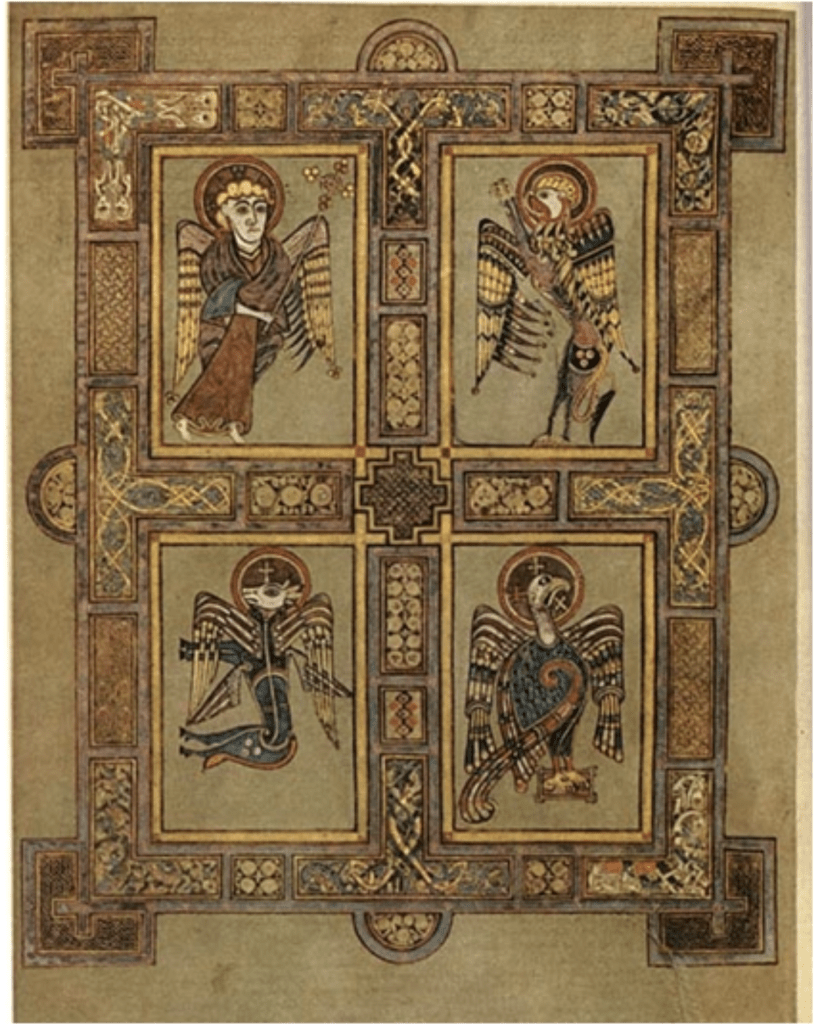
The first selected work is from the “Book of Kells,” a gospel book crafted in a Celtic monastery around 800 AD, and whose location of origin is often debated, but generally agreed upon by scholars, to have been Columban in nature. Specifically, we will examine Folio 27v, from the “Book of Kells”, one that depicts the Four Evangelists in animal form, representing the four stages or phases of Christ’s life.
The page is a well-preserved vellum sheet, most of which is filled with a glittering rectangle of intertwining and repeating swirls, snakes, and other geometric symbols. The main rectangle is capped on all four corners with more decoration and is divided into quarters by much of the same flat line work. This page is ‘illuminated’ via vibrant pigments applied to vellum made of calfskin. The colors used are indigo, canary yellow, red, and purple, mixed with egg whites to create a fast-drying tempera paint. The overall style of the “Book of Kells” is termed ‘insular,’ describing the intricate knot-work, one that the Celts were famous for, and spiral designs with overlapping lines, lack of three-dimensional qualities, and flat appearance to the forms.
In the top left quadrant, Matthew has remained in the form of man, as Christ was at his birth. Below Matthew is Luke as the oxen calf, as Christ was in his death. In the top right portion, is Mark, seen in his Lion form, representing Christ as he was resurrected. Finishing with John, the eagle, or Christ during is ascension to heaven. The animal forms of Matthew and Mark, Christ’s birth and resurrection mirror one another face to face, while John and Luke, Christ’s death an ascension mirror each other but in look away from one another. In the quartered boarders surrounding the Evangelists depicts interlaced snakes and chalices. The elongation of their forms enhances the mystical feel that these forms have and what they represent. Animal imagery is seen throughout the “Book of Kells”. Focusing on the snakes in the boarders, there are two meanings we can gather. The Four Evangelists are essentially ‘trapped’ within the confines of their respected rectangles and the snakes, in this context, could be seen as the warning and emerging threat of sin and hell. However, if we look to the other iconography that snakes in Christendom hold, we can see these snakes as representation of Christ proverbially shedding his skin, from one animal form to the next, as representation of the phases of his life.
This work is not only a labor of devotion and meditation in its construction, but also ‘illuminates’ the viewer with the entire life of Christ. It is a rather simplified display of the four people who are said to have wrote Christ’s life history, as representations themselves and of the four stages of that history simultaneously. This work represents how simple, flat-feeling manuscript illustrations can hold so much information, iconography, and symbolism in them to tell a much larger and longer story. I want to restate as well that the illuminators, and even the general location of the “Book of Kells” origin is widely uncertain. To me, this has to do with the artists’ devotion and the putting of their religion above all else first, as well as them not needing the validation or ‘fame’ for the credit of this book’s creation. To me that is the definition of spiritual expression when serving under a higher power.
I quite like this page, though I am very far from prescribing to an organized religion. It reminds me of a Christian mythical creature that I had read in a Sherlock Holmes story, where one form had attributes of all four of these separate phases. Little did I know then that that creature’s appearance had a deeper religious meaning. Regardless of the subject matter, the amount of detail and vibrancy of the colors, given the medium, is very impressive. The dedication to caring for this tomb is also evident in the preservation of such an old manuscript.
Renaissance
As the church fell out of favor, artists sought to express the human condition in a way that utilized Classical ideas married with realism. Ranging from early 1400s to the end of the sixteenth century and the art produced does indeed reflect these romanticism ideals, as seen in example work two, Caravaggio’s “Narcissus”.
Michelangelo Merisi da Caravaggio lived from 1571 to 1610 and was both witness and contributor to the genre of realism two-fold. The first part of the realist expression of Renaissance work was in the formal elements that Caravaggio utilized, such as chiaroscuro, defined and accurate anatomy to his forms, and an attention to detail that shook the Italian art scene. The second part of this ‘new’ sort of realism, is that artists were beginning to paint ‘real life’ and ‘regular people’. Gone was the ‘ideal figure’ and here was your average street merchant in settings ranging from tavern parties to religious storytelling. These ideas of the Renaissance, that were gathered around the rebirth of Classical ideals, such as beauty, and a focus on the human aspect of life under the lens of scientific observation, was Caravaggio’s area of expertise.
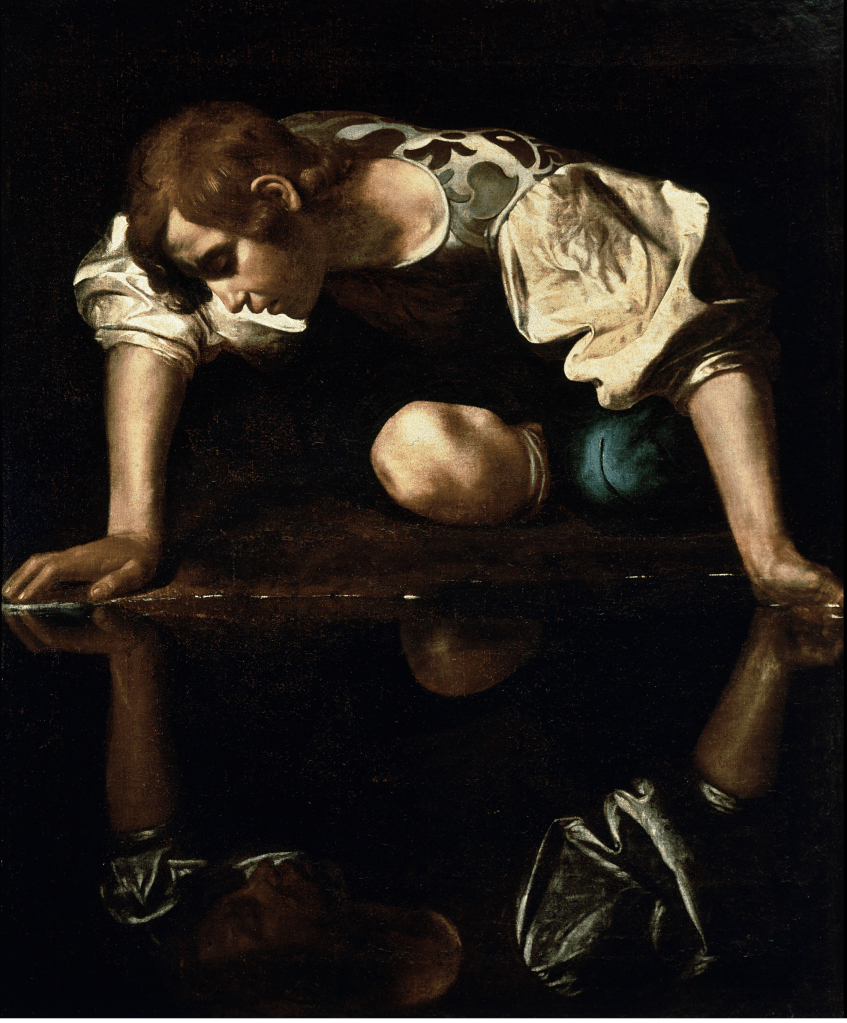
His ‘Narcissus’ brings us the ego incarnate- a young man, knees in the dirt, leaning over the cool, calm surface of a dark pool of water to see just what Narcissus sees in himself, an ordinary man caught up with the idea that he is all the world need offer to him. The majority of the canvas is dark to near black. Well-placed highlights bring us first to Narcissus’ face, then down his arms, to the water’s surface where we catch his reflection in the dark liquid beckoning him in. His right arm lowers his face closer as his left arm can’t help reaching forth, bending down, unable to resist the urge to get closer to what he wants. The man’s bare left knee juts out in a dash of highlight, a detail that did not necessarily need be included but shows us the desperation to reach a goal, as to level himself into the dirt. The expression on Narcissus’ face is that of pain and longing, but it is this expression for which he is obsessed, and it is this vanity that will kill him.
To me, this is the epitome of the Renaissance taken to the extreme. We see the Classical beauty in the construction of the arms, shoulders, and face, while showing the understanding of water’s reflective properties, highlighting the growing scientific knowledge of the time. Narcissus’ left arm dips into the water slightly, but not enough to disturb the surface, and thus his egocentric melancholy. The emotion upon his face is that of pain and longing, and the inability to stop himself. This loss of control is what the Renaissance artists were looking for while maintaining the technical skill of the Classic era but moving their subject matter and composition into a new light that sought to examine the individual.
Baroque
Much of the fanciful ideas of the Renaissance flourished between 1600 and 1700 as the Baroque period. This was a time of intense and dynamic emotional expression, and dramatic movement that sought to draw in the attention of the viewer in a world of grandeur and bourgeois lifestyles.
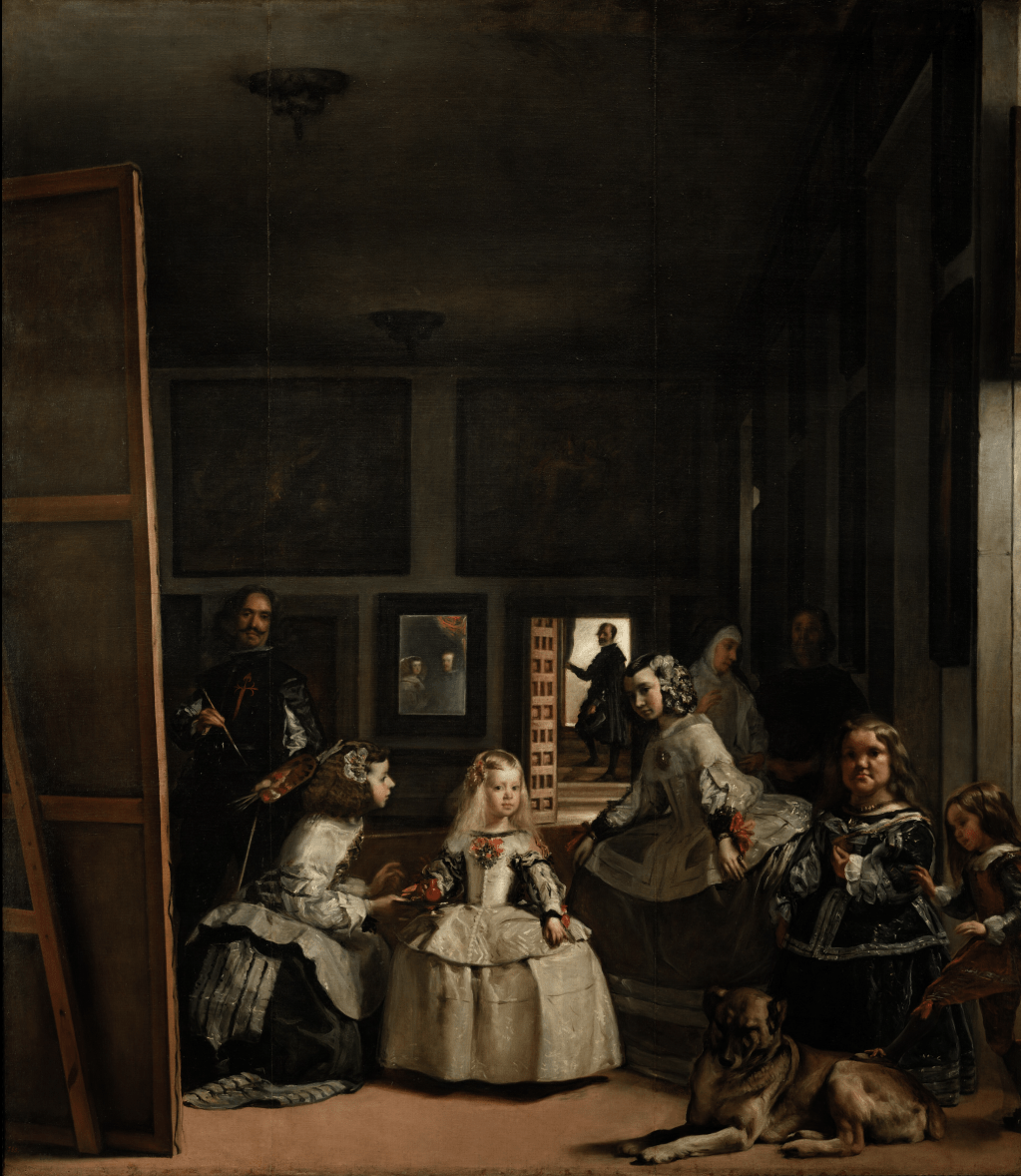
An absolutely wonderful visual riddle, we will examine Diego Velazquez’ “Las Meninas” painted in 1656 Spain. This oil on canvas is quite a substantial size, large enough to fit a painter (presumably Velazquez) and his large canvas, a small girl in an elegant silver dress surrounded by her ladies in waiting, two adults whispering in the back, a man escaping out a rear door, and the far wall that give the illusion of a gallery wall, but holds one of the main features, a mirror with two faces in it. Again, there is a great use of tenebrism to highlight what it is Velazquez wants us to see and darkens what is necessary but unimportant. There is a great sense of detail and use of space when viewed from afar, but up close, the simplistic brushwork seems almost impossible. These compositional choices give the work movement, sound, wonderful linear perspective, diminution, and chiaroscuro.
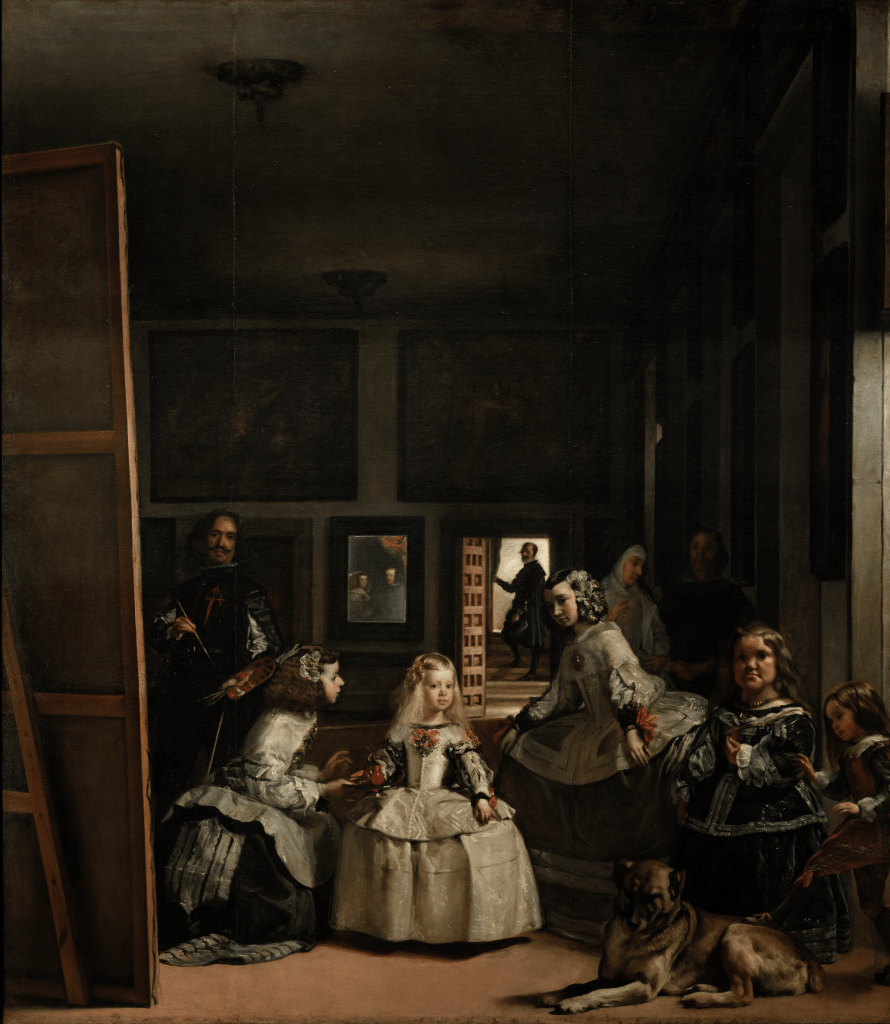
Under the eye of analysis, we are asked how these formal elements are used to create a story: who is who, who are we to be looking at, and what is the role of everyone to each other. The heavy use of tenebrism forces the eye to the group at the front, but Velazquez draws us to the back wall with the light let in by the mystery man exiting, for which we then see the mirror on the same far wall. In the mirror, we see the posed faces of King Philip IV and Queen Mariana of Austria; are we them, based of the perspective for which the actual viewer is seeing the room, or is the mirror reflecting the painting Velazquez is painting, needing not leave his wealthy patrons out of the scene unfolding before us. However, if it is the King and Queen as the supposed subject matter of the paintings within the painting, they why is our eye drawn to the little girl in the center. She seems to have the attention of almost everyone in room, yet this is, and simultaneously is not, a portrait of her.
There is such realism felt in this scene on the surface but when we look deeper we see what Velazquez is getting at. To me he is saying: ‘despite the chaos of the courts, religion, or what have you, look at what art can do.’ He has put himself here with us, actively working on perhaps this painting, with a brush and raw palette in hand, he looks directly at us, whoever we are supposed to be. The coy expression on his face is saying that he sees the real, everyday individual. Among all this luxury, he and us are the same. We are both his subject and his audience. “Las Meninas” is simply a fantastical work that will keep a special spot on my list of favorites for a long time.
It is difficult to select only three works to represent three very vastly different points in history and art. In doing so, one must search out to find the essence of that period, and a work that not only demonstrates immaculate technical knowledge and ability, but one that also accomplishes the need that art filled in a given geological location and point in time. While this paper has attempted to do just that, it is not without remiss that the jump from the 800 AD “Book of Kells,” to Caravaggio’s 1590’s “Narcissus,” and Valazquez’ “Las Meninas” in the mid-17th century, is not a smooth transition. Each great work from these time periods highlight a key feature about the political, spiritual, technical, and commonality influences of that great spans, and is the goal of every dedicated art history student, to lay eyes and mind upon.
Works Cited
Ghormain, Caoimhe Ni. (2025). Folio 27v Gospel of Matthew. Trinity College of Dublin. https://www.visittrinity.ie/book-of-kells-pages-on-display/folio-27v-gospel-of-matthew-2/
Photo credit of ‘Narcissus’ by Caravaggio: https://www.caravaggio.org/narcissus.jsp
Photo credit of ‘Las Meninas’ by Velazquez: https://www.museodelprado.es/en/easy-to-read/las-meninas-diego-velazquez/c43f1c8d-e6c9-a8c2-44dc-0c9be2e10177
Photo credit of Folio 27v from the ‘Book of Kells’: https://www.worldhistory.org/image/8039/book-of-kells-folio-27/
I would love to hear your thoughts on these works. Let’s discuss it in the comments below.
Thanks for reading,
K


Leave a Reply