The following is a college final essay I wrote on December 7th, 2024 for a college-level introduction to literature course.
If you find this article helpful for writing your own academic papers, please let me know in the comments below!
Unless directly cited, all content of this article is my own intellectual property. A works cited list is provided at the bottom.
Understanding the Mind and the Brain
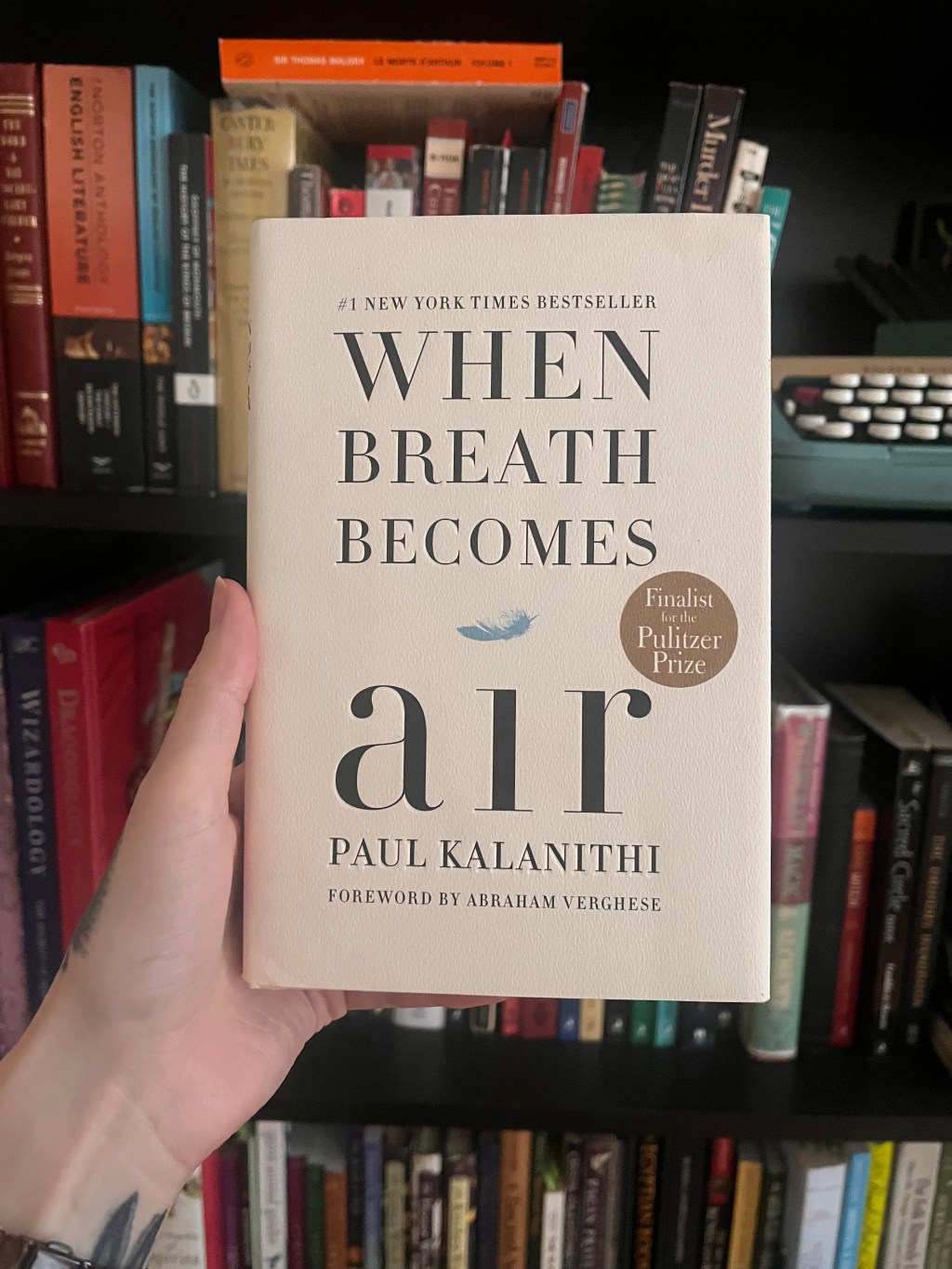
We often think of death, some more than others, but when you are faced with a terminal illness at what should be the peak of your life, death seems to reach for you wholly and without apology. Paul Kalanithi was a neurosurgeon, literary genius, husband, father, and cancer patient, all within the first half of his life. It is by his vigilant control of language to which we delve into the bright beginning, harrowing middle, and abrupt end of Kalanithi’s life in his memoir, When Breath Becomes Air, published in memoriam. Shortly into the memoir, Kalanithi gives a ‘life thesis’ of his own by pondering, “there must be a way…that the language of life as experienced— of passion, of hunger, of love— bore some relationship, however convoluted, to the language of neurons, digestive tracts, and heartbeats” (Kalanithi 39). This not only sets the tone for the rest of his book but also creates key features for the reader to think about themselves as they read on further. Kalanithi states, “I studied literature and philosophy to understand what makes life meaningful, [and] studied neuroscience… to understand how the brain could give rise to an organism capable of finding meaning in the world,” but what purpose does this serve (Kalanithi 35)? Does this mindset simply make him a better person, or does this make him into a better doctor as well? It is the goal of this paper to delve into Kalanithi’s understanding of the mind via a study of literature and the brain via neuroscience, and how he used this to find a unique perspective and direction to take with how he cared for his patients medically and emotionally.
An early love of literature, fueled by his mother, gave Kalanithi the gift of a Romantic mindset that shaped his perspective of medicine and patient care during medical school. Kalanithi’s mother worried for her children’s education which instilled “a deep love of, and care for, language” which can be witnessed by the numerous references to novels he read in his adolescence throughout the memoir and how those themes surfaced as he learned about anatomy and clinical pathology (Kalanithi 26). It would be this application of literary themes and ideas to facing the cycle of life and death that would open his already wandering mind to contemplate the mind and the purpose of life. It is clear throughout this book that Kalanithi has a real command of language. A prime example of how his appreciation and dedication to Romantic literature within this memoir is seen when he describes the feeling of graduating high school: “suddenly there was a feeling in our high school that the two mountain ranges that bounded the town no longer defined the horizon: it was what lay beyond them” relating how his life was no longer bound by the mountains either as he moved away to attend college (Kalanithi 28).
When listing out some of the great works that impacted him most, he states that “Brave New World founded [his] nascent moral philosophy” using this book to write his college admission essay arguing “happiness was not the point of life” exemplifying his search for the meaning of life, which reached further than just simply being happy (Kalanithi 27). He claimed that “the most intoxicating thing [he’d] experienced, by far, was the volume of romantic poetry” proving that his heart was in the right place to ponder such wide-reaching wonders such as the meaning of life, as he began to witness its creation and destruction during his residency (Kalanithi 27). He states that stories like Hamlet became his “closest confidants” that provided “new views of the world” which corresponded to the sort of crossroads he found himself in during the end of medical school (Kalanithi, 27). Even though the passion for unveiling the human condition filled his mind, he needed more. Kalanithi admits that “my brief forays into the formal ethics of analytical philosophy felt dry as a bone, missing the messiness and weight of real human life,” something he would find in abundance as he became a practicing neurosurgeon (Kalanithi 31). With his ever-evolving understanding of the mind and a desire to delve deeper, Kalanithi then moved to the organ that housed what made a person a person. The brain.
Neuroscience is one of the more demanding specialties a doctor can choose when going into their first year of residency, but the need to pursue his own philosophical quest of understanding the values of experiencing life compelled Kalanithi forward. Kalanithi’s connection to literature came from an early passion for reading and exploring the human condition with his connection to nature; this brought him around to wanting to study medicine with the idea of understanding both the brain as a vessel for the mind and how it functions physically to do so. He firmly believed that humans are soul-bearing creatures meant to experience the world and all that it has to offer in the philosophical sense but maintained the idea that “though we had free will, we were also biological organisms” keeping true to his gemini mind, that there was two major sides of life to conquer and comprehend; the mind and the brain (Kalanithi 30). Kalanithi’s childhood and adolescence sought to discover how the human existed in the world in regard to the mind and soul, but he searched for a way to apply these theories on a base, physiological way, which lead him to neuroscience. Now, deciding to go forward and become a doctor, Kalanithi knew that “literature provided a rich account of human meaning; the brain, then, was the machinery that somehow enabled it” and felt that focusing on neuroscience was the way to get there (Kalanithi 30). After diving fully into his chosen field, Kalanithi still maintained the theory that one must have both a literary mind and a scientific one if they are to find their purpose and understand those around them. He “still felt literature provided the best account of the life of the mind, while neuroscience laid down the most elegant rules of the brain” a division of study, but not a wholly separated body of thinking (Kalanithi 30-31). As he got into the life of caring for patients as a neurosurgeon, he found that “when there’s no place for a scalpel, words are the surgeon’s only tool,” a motto every student should hear before becoming a practicing doctor (Kalanithi 87). Now that Kalanithi had married together the study of literature and language with the demanding and complex field of neuroscience, Kalanithi was to soon apply these tools to caring for his own patients.
With a well practiced theory of meshing the ideal of literature with the rigorous structure of neuroscience, we can see how Kalanithi used these two functions to improve his patient care and help him answer his own life purpose. One of the major epiphany moments that he had was toward the end of medical school when he finally “saw the human relationally [he] had written about as an undergraduate realized in the doctor-patient relationship” which helped him see his patients as more than just a disease (Kalanithi 51). An article in the Journal of General Internal Medicine found that data suggested that patients who “participate in their care do better biologically, in quality of life, and have higher satisfaction” with that care, which will never come about if the patient has a poor relation with their doctor (Goold & Lipkin S26). A similar theory was stated in the International Journal of English and Studies, by Ruth Sheribha, where they observed how “[Kalanithi’s] initial interest and academic background in English literature play a crucial role in shaping his comprehension of illness and coping mechanisms,” giving light to his own development into the compassionate doctor he was (Sheribha 140).
We can see the further development of his interest in proper patient care and meaningful patient connection in his senior year of medical school. Kalanithi’s class visited a home for those who had suffered brain injuries where he learned how often people like this are virtually abandoned by their families. He was enraged by the callous way that the tour guide had told him that caring for these patients was ‘hard’. Not only did this anecdote show his passion for patient care early on in his career, but it led him back to that ‘life thesis’ of the connection between an emotional investment and medical investment in order to be the doctor his patients deserved. He believed that “literature not only illuminated another’s experience, it provided…the richest material for moral reflection”, in that he believed that through the personal narrative he learned of by getting to know who his patients were, gave him the insight to treat them as the individual and not just the disease (Kalanithi 31). This observation is further supported by Kalanithi’s statement of “when you work in a hospital, the papers you file aren’t just papers: they are fragments of narratives filled with risks and triumphs” (Kalanithi 73–74). Kalanithi was able to witness this theory first hand when watching a surgeon tell the parents of a child with a brain tumor what her treatment plan would look like, remarking in awe on how, “he not only delivered the clinical facts but addressed the human facts as well” cementing the need to treat patients and their families as they are, humans (Kalanithi 69).
While getting into practicing medicine out of medical school, literature was always in the back of Kalanithi’s mind as he applied ideals and theories from the stories he grew up reading when talking to and treating his patients. By taking an interest in his patients, Kalanithi was able to use the life lessons of compassion and understanding toward the human condition, in order to create meaningful doctor-patient relationships, even with those he only saw once for surgery. The doctor-patient relationship is not only a legally binding contract for medical care, but a truly good one can increase patient compliance and overall wellbeing that is directly reflected in their ability to cope and heal, as well as “directly finds the quality and completeness of information elicited and understood” by the patient (Goold & Lipkin S26).
Another application of Kalanithi’s literature-neuroscience theory is seen within the creation of When Breath Becomes Air. In the middle of his cancer treatment, becoming a patient himself, Kalanithi wondered “how little do doctors understand of the hells through which we put patients,” asking the pivotal question of how much do doctors care for their patients as people (Kalanithi 102). Perhaps, this is one of the many things that prompted him to write his memoir from the perspective of the doctor turned patient, in order to give a first-hand account of being on both sides. Kalanithi’s memoir has inspired analysis of how When Breath Becomes Air works as an exemplar for how “the power of words has revealed the path to recovery on both sides, physically and spiritually,” proving that a illness narrative can be beneficial to read for both fellow patients and the doctors that are treating them (Bouzaine &Boukhelef). Sheribha also makes the supporting claim to this that “engaging with literature…offers a profound way to navigate terminal illness’s emotional and psychological challenges” (Sheribha 141). Life is all about experiences, and through Kalanithi’s metamorphosis from student, to doctor, to patient, we have seen just how compassionate a doctor with the mind of a surgeon and the heart of a poet can be.
Throughout this compelling and thought-provoking memoir, we watched as Kalanithi had tried to choose between literature and neuroscience, and though he took the neuroscience route for the bulk of his life, it was by returning to writing at the end of his disease that provided him with the best avenue for self-reflection and expression. When Breath Becomes Air is an illness narrative story but also gives insight into the way in which students are shaped into doctors during medical school and the sort of metamorphosis that they must endure themselves to come out on the other side. This type of story is impactful for not only the reader, especially a cancer patient and their family members in this case, but for fellow doctors to gain insight to how patients handle treatments, and the author as well, by giving voice to their experiences and finding solace at the end of their life. However, without his desire to decode the human brain as an organ and how that structure fit with the complex situation of human consciousness, When Breath Becomes Air may have not existed to begin with. It is this unique marrying of life-inquisitions that set Kalanithi at the cusp of the new horizon in which patient care can be significantly improved.
Works Cited
Bouziane, Latifa Zaine & Boukhelef, Faiza. “Literature as a Psychological Therapy During Covid-19 Pandemic, Paul Kalanithi’s When Breath Becomes Air as a Model”. Academic Scientific Journals Portal, vol. 9, no. 2, Mar. 9, 2023, https://asjp.cerist.dz/en/downArticle/136/9/2/217522.
Goold, Susan Dorr & Lipkin, Mack Jr.. “The Doctor-Patient Relationship: Challenges, Opportunities, and Strategies.” Division of General Medicine, vol, 14, no. 1, Jan. 1999, https://pmc.ncbi.nlm.nih.gov/articles/PMC1496871/.
Kalanithi, Paul. When Breath Becomes Air. Random House, 2016.
Sheribha, Ruth B. “Illness Narratives: A Study on Body Image in When Breath Becomes Air by Dr. Kalanithi and The Cancer Journals by Audre Lorde”. International Journal of English and Studies (IJOES), vol. 6, no. 8- Aug. 2024, pp. 134-142, https://www.ijoes.in/papers/v6i8/18.IJOES-Sheribha%20Ruth(134-142).pdfliter.
Let me know your thoughts and as always, thank you for reading.
K


Leave a Reply